Thriving in Grad School
July 13, 2026
This essay is based on a talk I gave a few times to incoming PhD students in computer science.
Graduate school looks like school and college. It has courses, exams, advisors and professors. The resemblance is only superficial. A PhD treated like school, or worse, like a job, becomes years of grinding toward grades nobody will care about, and toward a paycheck that is never the point.
Graduate school is closer to an apprenticeship. It is a supervised practice of learning to learn and learning to think under uncertainty. It is conducted with someone who has gone through the process before, alongside others who are learning the same thing.
Apprentices or Peers?
By the time the first year is a few months in, a student builds a strange kind of intimacy with people they have never actually met. The student encounters the Turing machine, the von Neumann architecture, the Liskov substitution principle, LeCun’s convolutional networks, Dijkstra’s algorithm, the Cook-Levin theorem, Valiant’s PAC framework and so on. These individuals attached to these tools are encountered often enough that they stop feeling like citations and start feeling like acquaintances. The original papers may get read with a reverence undergraduate work rarely demanded. Once familiarity sets in, the instinct is to read the accumulated list of names as an entry into a group of peers who did what the student is about to start doing.
That instinct is wrong.
Peer implies parity. Parity invites comparison. Comparison with Turing is a contest nobody new to the field can win. It is certainly not encouraging to a first-year doctoral student.
The list names a different kind of relationship. Nobody becomes Turing’s peer by enrolling in a PhD program. They become his apprentice, in the same sense that they are apprenticed to their own advisor: studying how he worked rather than seeking to match what he achieved. The study should look for how he failed at something and found his way back to it. Unfortunately, failures hardly ever make it to papers, and so are hard to learn from. Turing is not a peer. He is a teacher we happen to have never met. And von Neumann. And Dijkstra. And LeCun. And the uncredited heroes too.
The people mentioned in this essay are publicly recognized for their contributions. The average PhD-holder is not. By focusing on the named individuals and their trajectories, the essay seems to indulge in survivorship bias. To a certain extent that is unavoidable. One of the points the essay makes is that we can all learn from the greats, whose careers were not always straight marches to success. Their failures, and subsequent responses, are as instructive as their successes. However, we are more likely to be influenced by unnamed heroes around us, whose successes, failures and responses to failures can be as instructive as those of the celebrities.
This essay is about idea that resilience is the foundation of a successful graduate school experience.
The Upside-Down Year
Nearly everyone arriving in a PhD program has spent their entire academic life near the top of every class they have taken.1 Within a year, sometimes within a semester, that often stops being true. Courses get harder. For the first time, grades are not reliable indicators of effort. At the same time, the actual research, the thing the classes were supposed to prepare a student for, mostly does not work. Two sources of identity collapse. We can call this phase under-informed disillusion. This is the second of three phases most students pass through, sitting between the uninformed exuberance of arrival and the hard-won, durable confidence of an actual scientist.
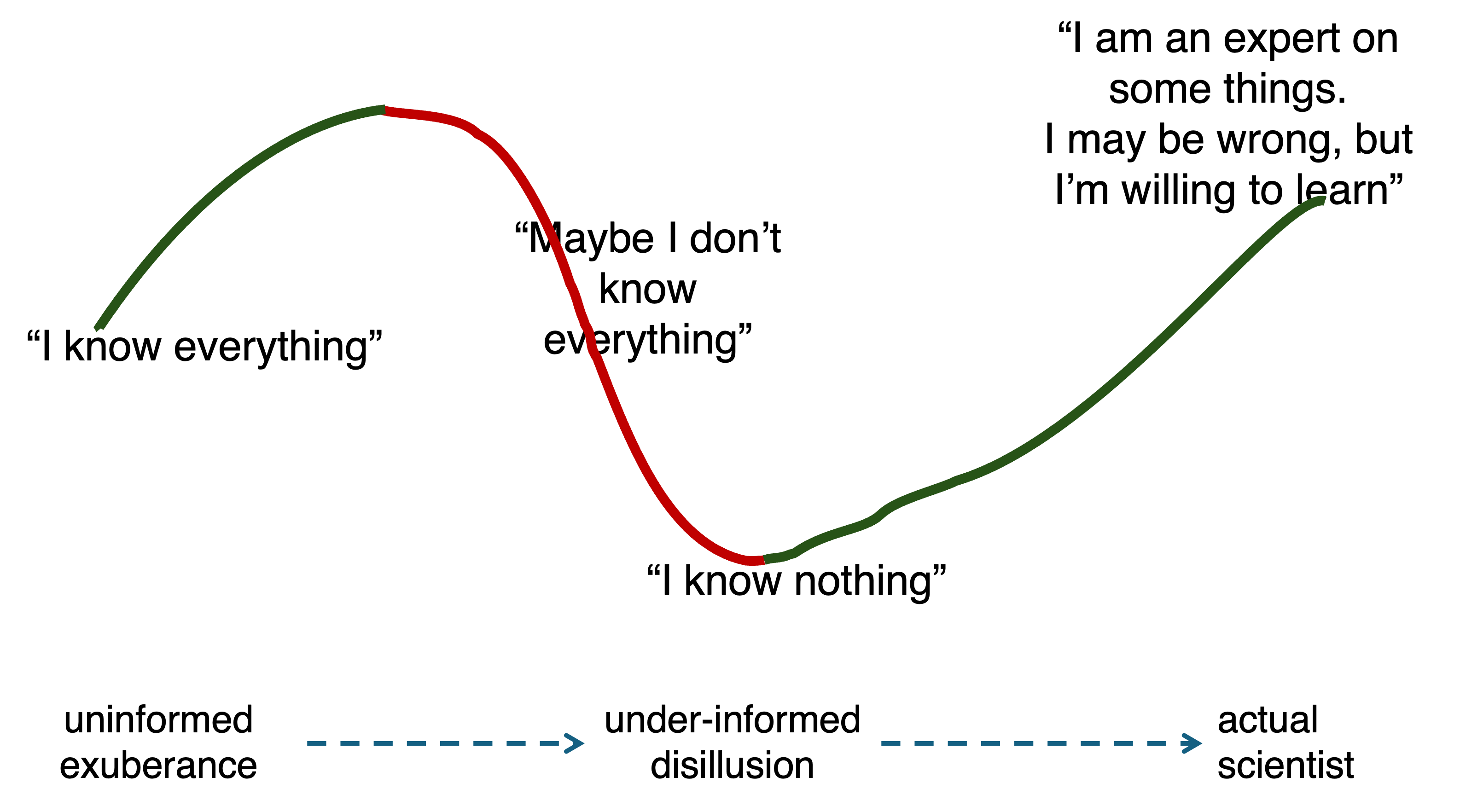
The phases of a PhD
We can picture this journey with a simple plot.2 Why does the dip happen? And why does it feel so much worse than it should?
The explanation is that though it may be mistaken for a personal failing, the dip is the result of a structural asymmetry. Every student in a department can see everyone else’s successes: the accepted paper, the fellowship, the offhand mention of something that worked. Almost nobody sees anyone else’s failures, including their own labmates’. Culturally, failure is private by default and people choose to only announce success. The asymmetry is sharpest against the historical greats. Their entire visible record has been curated by decades of retrospect into a highlight reel. The dead ends are quietly edited out. The person at the next desk also supplies a milder version of the same asymmetry. Social media supplies a third version, and it is not mild at all. It is an endless, worldwide feed of successes: accepted papers, fellowship announcements, conference photographs and so on. Each post is a small act of self-curation. But nobody scrolling past has the time to recognize the curation because the next one arrives. The historical record edits itself slowly, across decades. Social media edits itself by the hour.
A student weighing their own raw, internally visible struggle against everyone else’s curated, visible success is running a rigged comparison.
Why pursue a doctorate at all?
The right reason to pursue a PhD is the desire to push at the edge of what is currently known, possible or understood. All the other outcomes of the grad student experience are byproducts.
Wanting to be one of the names on that opening list is a different motive than any of those. But it can be a trap. Except for rare instances, the actual work that matters may involve the patient pursuit of a question nobody yet considers important. It may even need the willingness to be visibly wrong for years on a direction the field has not endorsed. While it is happening, this kind of work may look unproductive and unprestigious. But history might be judge it as surprisingly impactful. Someone optimizing directly for eventual greatness will systematically avoid such work in favor of whatever everyone else decides is impressive. Quite likely, they will never produce it. Wanting to be great as an end goal is unhealthy, and worse, self-defeating.
For a doctoral student, there is also a timeline problem with chasing visibility or recognition or greatness directly. Let us look at an example. Judea Pearl’s foundational work on probabilistic reasoning followed a long temporal arc: the doctorate came first, the defining contribution years later, the formal recognition decades after that. It is unlikely that he was optimizing, as a graduate student, for a recognition that would not arrive within his own department’s living memory of him as a student. What he was doing, as far as the record shows, was working on questions he found genuinely unresolved. Achievement eventually followed.
Papers and Dissertations
The end goal of a PhD is a dissertation. Along the way, a student may write several papers.
A research paper, stripped to its bare bones, contains four things: a problem that is not yet understood or not yet solved, a question that follows from that problem, a strategy for approaching the question, and evidence in the form of results, proofs, experiments, or data.
A thesis asks for a falsifiable claim: that some specific X is novel, feasible, and useful, or, less often, that X, which the field assumed was possible, turns out not to be.
There are many false versions of a thesis. “I ran many, many experiments on X” is not a thesis. “I trained a neural network to do X” is not a thesis. “I worked for a long time, and it was hard” is not a thesis, even though it happens to be true of nearly everyone in a graduate program. All three, and many more, share the same defect: they describe activity. Activity is not achievement.
Papers and dissertations are the result of a process, and a sequence of questions, that is steeped in failure. Rather than describing this in the abstract, let us see the questions for a concrete idea. Imagine we are working on a new way to compress a neural network. Is the problem important? Maybe, if the approach and the neural network itself matter to anyone outside the room. Is it relevant to what the field cares about? Has the field already found workable solutions? Suppose the idea survives both questions. Is the idea feasible with the time and compute available to us? Suppose it is. Do we know what counts as a correct test for the claim? Is the data available to test the claim something we can generate or access? Most ideas, including many good ones, die somewhere in that sequence, often at the first or second question, long before anything resembling code or an experiment exists.3 An idea may also meet the chopping block because of the vagaries of the peer review system.
The death of an idea is not necessarily failure. Independently rediscovering something already known in the literature is a success, even if it will not be published. Finding something too small to matter to anyone else but instructive to the person who found it is a success. Sometimes the only outcome of a month’s work is that the process itself got practiced. That too counts, at the level of a single attempt.
Of course, none of this lowers the bar for the dissertation itself. The dissertation must be novel, feasible and useful, without exception. The generosity in the above paragraph belongs to the individual attempts on the way there, but not to the claims the degree finally rests on.
But where does an idea worth attempting come from?
Where Ideas Come From
T. V. Raman did not go looking for a gap in the literature. He arrived at Cornell seeking a PhD in applied mathematics. Within his first year, he discovered that listening to mathematics, rather than seeing it, can be hard. It throws away almost everything the eye gets for free: the ability to glance ahead, to hold a whole expression in view while parsing one part of it, to tell immediately whether a fraction’s denominator is a single term or a sum. Raman is blind. The need to read his own coursework led to his dissertation titled Audio System for Technical Readings. He won the ACM’s award for the best doctoral dissertation in computing in 1994.
That is about as pure an instance of intrinsic motivation as it gets. But most students will never have a research question forced on them by something as urgent. The generalization is that an idea must answer to something real for the person pursuing it. It does not have to answer to what currently looks fashionable or to what will read well in a report. Sometimes that realness is a need as sharp as Raman’s. More often it is just a question that just will not stop being interesting.
Clocking Ideas
Alan Kay, as a graduate student at Utah in the late 1960s, saw an early demonstration of flat panel display technology. Not long after, seeing the Logo programming language and Engelbart’s Mother of all Demos left him convinced that a personal computer the size and weight of a notebook was inevitable. The hardware to build one did not exist at that time. It would not for decades.4 Kay spent much of the rest of his career inventing things that were needed to realize his conviction, namely a graphical interface and an object-oriented programming language. Neither of these was the dream itself. They were the scaffolding the dream needed. The device he had pictured has not arrived yet. Tablets like the iPad match the form of Kay’s vision. But by his own account, they fall short in what they allow children to do.
Raman’s idea arrived almost as fast as it could be produced and was recognized quickly. Pearl’s defining work took a decade to arrive and decades more to be recognized. Kay’s vision outran the available hardware so badly that he had to invent intermediate technology just to get partway there. The actual destination has not yet been reached.
Lined up next to each other, these stories are evidence against the notion that there is one acceptable shape for where ideas come from, how long it takes for an idea to take form, or how quickly the world notices it. What stays fixed across all three is whether the work was real. Activity is still not achievement, however fast or slow the clock runs.
Illusions of Progress
Most of what derails a doctorate falls into one of two families.
The first family is avoidance dressed up as virtue. Perfectionism refuses to ship work because shipping it would expose a claim to the risk of being wrong. But research requires risk. Waiting for inspiration before starting is the same avoidance wearing a more sympathetic face. The remedy is to read around the problem, to talk to people, to simplify, to give a talk describing the confusion, and to write, even badly or with nothing yet to say. Writing not only records thinking but also stimulates thinking.
Avoidance can show up disguised as due diligence and spur a student to learn indefinitely by taking every interesting course on offer and refusing to ever call the preparation finished. Procrastination and silence travel together: going quiet when stuck is the cheapest possible way to delay the moment a piece of work must face anyone’s judgment, including one’s own.
If one family of derailments involves failing to try, the second family is a failure in judgment about what is worth attempting. Chasing grades optimizes for a credential future employers or collaborators hardly care about. Also in this family is scope mismanagement in both of its common forms: wanting to solve every problem in the world at once means never getting deep enough on any one of them to say something new, and wanting to solve a problem nobody needs solved means achieving real depth in something that does not matter. Both failures stem from never running the idea through the sequence of questions, importance, relevance, feasibility in the earlier section. The maximalist never reaches feasibility. The minimalist never reaches importance.
While perfectionism and scope-creep are forms of self-deception, the ultimate and most fatal derailment is outright deception: misconduct. Everything else on this list is a person avoiding risk or misjudging what matters. Fabricating a result, or copying work without citing it, is dishonest. Misconduct is a way for a person to avoid the risk of being wrong by lying about whether the risk was taken at all. Misconduct is also a lapse of judgment about the value of honesty. It is a way of manufacturing a fake success so the real failure underneath it is never revealed and recovered from.
The Single Practice Underneath All of It
There is a teaching, more associated with meditation than with computer science, that answers a question almost every beginner asks: how do we get around constantly losing concentration? The answer given is that losing concentration is not a failure of the practice. Noticing the loss and returning, without treating the lapse as a verdict on the person, is the entire practice. The teaching goes beyond meditation. It is a clear description of the one skill running underneath everything in this essay.
A stalled experiment on a Thursday afternoon is a small, fast version of that motion. Notice that the current approach failed, do not treat the failure as a personal judgment, and return to the problem. The three-phase arc of an entire doctorate, i.e., exuberance-disillusionment-scientist, is the same motion stretched across years instead of an afternoon. A career that does not pay off until long after the degree is the same motion again, run at a scale that outlasts a single advisor relationship. These are not different skills practiced at different moments. They are the same skill, practiced at different clock speeds.5
Seen this way, the usual advice for being a good graduate student stops being a list of separate virtues and becomes a set of frequent repetitions of that one skill. Writing daily, even when there is nothing yet worth saying, is a low-stakes move of exposing a half-formed thought to scrutiny without judgment. Presenting work while it is still confused, in a group meeting or at a workshop, is the same practice with an audience attached. Capturing an idea the moment it appears, before the person who had it talks themselves out of its merit, protects a fragile attempt long enough for it to be tested properly later. Mastering the actual tools of the trade, such as the proof techniques, the experimental protocols, version control, typesetting and so on are easy gains in the practice.
None of this needs to stay confined to research itself. What happens outside of research is important. We live in a messy world with deadlines, visas, funding cliffs, political turmoil, families that measure success differently from what this essay describes, partners with their own careers and so on. There are no easy answers on that front. This essay does not address such questions about life and survival. But, when those are stable and the student has the luxury to fail well, can external factors help sustain a creative practice?
Outside interests like running, climbing, bridge or golf still earn a place in the practice for two separate reasons. First, sustained creative attention depends on more basic needs like rest, health and a life outside the lab. A doctorate pursued at the expense of everything else does not produce more or better research. It eventually produces less and worse. The second reason is more subtle. A misplayed bridge hand, an uncomfortable hike, a round of golf gone wrong, or a tiring run delivers the same notice-and-return motion described above. But nobody shows up at a bridge game intending to practice failing. It does not feel like practice. It feels like Saturday, which may be why it works. A discipline that announces itself as a discipline is begging to be skipped. One disguised as fun rarely gets skipped at all.
The advisor relationship is where this entire practice gets watched in person rather than inferred from an essay like this or a list. An advisor provides mentorship and funding; in return, a student provides hard work and a genuine attempt at research, and the doctorate that results belongs to the student, not to the advisor who supervised it. What passes between the two of them, more than any specific piece of guidance, is the chance to watch someone further along fail at something, in real time, and return to it without flinching.6
This is apprenticeship made literal. It is a disposition demonstrated up close, often weekly, until it becomes available to copy.
Thriving in Grad School?
That is the title of this essay. The word “thriving” should sound slightly wrong. It suggests an arriving to a stable condition and then remaining there, the way a plant thrives once it finally has enough light and water. Nothing described here works that way. What gets practiced and watched closely is never a destination. It is noticing a failure, returning to it without treating the failure as a verdict, and doing that again. This happens at multiple scales: at the scale of an afternoon, a PhD and an entire career, alongside people, some down the hall and some dead for decades, doing the same thing.
A better title would drop the promise of arrival altogether. A better title of this essay is An Apprenticeship in Failing Well.
-
There are very rare exceptions. Jeff Erickson has written about his undergrad GPA being low. ↩
-
This simplistic picture is inspired by Kurt Vonnegut’s wonderful lecture on the shapes of stories (Youtube link). The specific shape here is the first one that Vonnegut talks about: Man in Hole. ↩
-
The Heilmeier Catechism represents the more thorough vetting of proposals. ↩
-
The exact sequence of demonstrations that produced the conviction has been told a few different ways over the years, including by Kay himself, so the specific details should be taken as a good story rather than a settled one. ↩
-
The notice-and-return practice can help with failures that originate in the work (such as experiments not working and unclear next steps) but not with failures imposed from outside (such as institutional dysfunction and resource issues). The latter class of failures are outside this essay’s scope and need practical problem solving or escalation. ↩
-
This paragraph describes an advisor-advisee relationship that is functioning well. Not all do. There is a power asymmetry in the relationship. Moreover, a missed deadline or a failed project usually has less impact on the advisor than the student. Students with dysfunctional advisor relationships should seek mentorship elsewhere. Senior students, other faculty and even members of the broader research community could help. The apprenticeship model still holds in this situation, but not with the advisor. ↩